terça-feira, 3 de março de 2020

Giving space to speak — Final Fantasy XII and its political choices


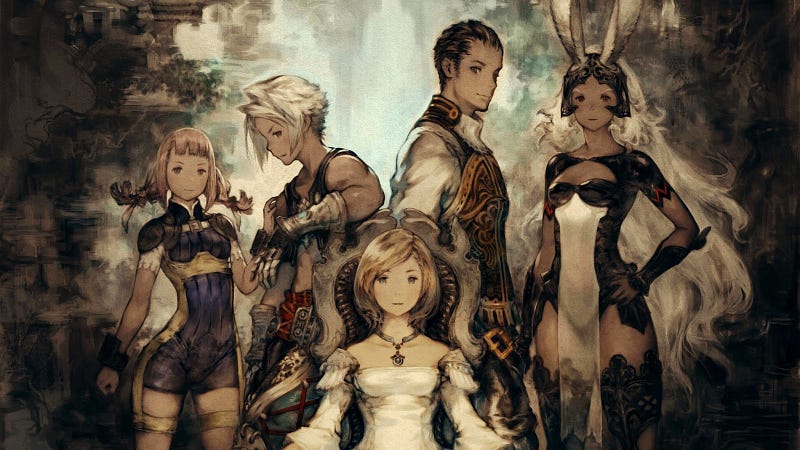
Despite the efforts of so many people trying to demonstrate the politics inherent in games, we have a lot of work to be done still. As a product of fiction, a game is produced in a period of time as well as in a place, which puts it in a position of a medium used to represent beliefs and social values from the context it is created. One aspect of its political dimension is related to the narrative it presents and to which characters are given the entitlement of speaking. In fact, we find examples of it in Final Fantasy XII. In a techno-fantasy setting, there are some signs that the producers were concerned with which voices are going to be heard and from which point of view the story is told.
Final Fantasy XII is already a very popular title of the franchise, but you may have no idea what it is about, so here goes a very quick overview. In Ivalice there are countries fighting each other and one of them, Archadia, is a military potency that invaded Rabanastre, the city where everything begins. Reclaiming Rabanastre from the Empire is the main plot of the game while you help a fugitive princess to get power enough to fight for her people.
The game gives you the opportunity to understand that while the big players made their choices and fight for their own interests, all Ivalice suffers consequences from their actions. Final Fantasy XII brings in this point by giving you the control of a group of outcasts whose ideas or actions have no effect directly in the world and whose words are not listened in the vast halls where the court meets. However, ironically, they are the ones who are really fighting to change the world.
Already at the beginning of the game, the perspective of the marginals is presented. In the tutorial, we are supposed to learn the basics while we control a soldier in a sort of invasion that we are not sure about its reasons or if we agree with that. The decisions were made for us, but the bodies and the energy used in the fights are ours. We cannot ignore the orders given to us since there is only one way you can go in this part of the game. No form of resistance is proportionated.
I need to warn you about some spoilers here. However, I do not think it should be deemed a spoiler since it all happens in the first ten minutes of the game.
Even though, consider yourself warned!
Your fate is in the hands of the powerful. After running through some corridors and beating some enemies, your character is attacked and almost die. His life is spared as part of a strategy. In some way, it is shown how lives are conducted by the conflicts of kingdoms and that the citizens act based on their faith in their rulers. The way the game presents this whole situation is far from being romanticized since it shows the coldness of how all happens and how fast people like our soldier is forgotten.
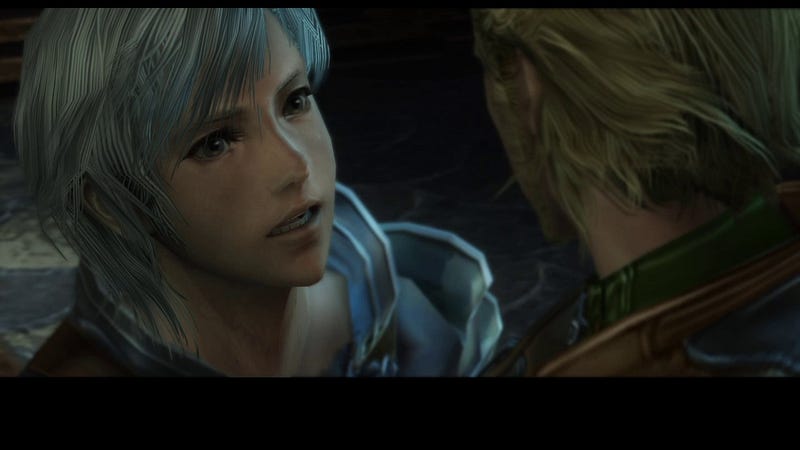
Time passes and you are presented to one of the main characters. Vaan is an orphan whose brother, his only family member alive, died during the war. His life was drastically changed by it and he grew up thinking about revenge as well as hating the Empire. As a poor kid, he grows up learning to take care of himself, stealing whatever and whenever needed, but not from everyone since he follows a moral code as expected from a protagonist of a Final Fantasy.
If you wander a little in some forums you will possibly see complaints about Vaan having the role of a main character. He is not alike the type of protagonist we are used to because he is not supposed to transform himself into an altruistic hero whose only purpose is to save the world. He is a normal person and we are not usually impressed by a normal life with its weaknesses.
Nonetheless, in the position of a protagonist, Vaan depicts us another perspective through which we can know more about the society of Rabanastre. How is the poor living in this whole situation? And how the decisions made by the rulers of Rabanastre falls upon the lower social classes? Vaan’s anger is not only from what happened to him as a person, but it is the same feeling a lot of Rabanastre’s citizens have. His dream of getting out of there in an airship represents the yearning people have for freedom. Placing Vaan as a protagonist is an act of representativeness that empowers people who can relate to his situation.
Surely it is hard to say that Final Fantasy XII kept all the way a very progressive political agenda in its narrative. For example, the story of Vaan is directly associated with Penelo, his childhood friend. They have similar lives to some extent, but he is still a man while Penelo deals with a lot just because she is a woman. The game earns its credits for what it does right. However, we can ignore that fact little is told from Penelo’s perspective. We are not allowed to go deeper into her thoughts since most of the time she is just an observer or the one whose role is to rationalize Vaan’s behavior.
In the end, Final Fantasy XII may not conclude its story keeping the proposition of integrating all voices. Nevertheless, it gives us great examples of how social agendas can be incorporated into a game. Games may tell us great stories about common people who usually society gives no attention at all. It is also our duty to analyze and criticize works that do the opposite, silencing the ones whose voices are already not heard. But first, we need to accept that a game, as cultural production, is political.

terça-feira, 7 de janeiro de 2020

Between life and death: the questioning of dichotomies in Death Stranding


At the beginning of Death Stranding, you are certain of two things: you must walk long distances to deliver a variety of packages and you will need to deal with some kind of ghosts that will try to kill you. Simple as that. Whilst it gets along and characters are presented, it is possible to distinguish a characteristic among them. Kojima’s characters have names that sound very obvious and cheesy. Nonetheless, their obviousness has a role: to lead the player in a way of questioning the duality of key notions from their own world.
 Before starting Death Stranding, I knew about the character played by Guilherme Del Toro, but I thought he would just be a special guest who would appear for ten minutes. However, his character, Deadman, turns out as a special element in the whole craziness that Death Stranding introduces us. His importance in how the story unfolds is the same as in what he, as well as other elements, represents. Even though the way he is presented, as a type of monster of Frankenstein, makes the fact of his name is Deadman risibly, he still pretty much alive in front of you.
While in Death Stranding, we find it difficult to define what is alive and what is dead, the rest of the world questions the difference between nature and technology, as well as human and nonhuman for example. However, unlike the former, the latter are confined in academic contexts, encrypted by the intellectual vernacular. Kojima’s newest work may not be the first game to question dichotomies, but its strength may be positive to the discussion.

A dichotomy is a division between opposite ideas. Life and death. Good and evil. These are found in most of the western societies and they function as a base for how we see the world. It is after considering someone as a human and someone or something as a nonhuman that things such as the human rights start to make sense. Although, accordingly to the philosopher and feminist Rosi Braidotti’s work, the division between what is human and what is not is a dangerous practice. The idea of a human as an unquestionable truth was challenged by the movement anti-humanist lead by some French intellectuals, like Foucault, which helped to demonstrate some power relations and inequalities sustained by it.
Death Stranding’s world, in a sense, provides a prolific context to keep with the anti-humanist movement, since it is constantly pushing dichotomies to its maximum. Among its characters, we have Deadman and Fragile. While they are playing with words with their names, we must push forward the idea of what is a man who is dead but also alive? And what about a girl whose name gives us a description which contradicts how strong and tough she is? Their existence contradicts the duality on which they connected.
There is another point where we can visualize this whole idea of deconstructing dichotomies. Whenever you are going through an area of BTs and you are caught by one of them, the whole area transforms. A giant BT appears and you can only run or fight. After the fight regardless of the choice you made, many fishes lying on the floor will appear and that can only be explained by the notion of the convergence of worlds. Two places become one and during those minutes you are throwing blood grenades it is too difficult to say where exactly you are.

Nevertheless, the BBs are the most significant element in the whole game to represent the exercise of questioning dichotomies. A bridge baby is taken from their mother’s womb who are called “stillmothers”, since they are brain dead, although their bodies are sustained by the UCA. Deadman specifies in Chapter 6 that bbs are in a zone between the world of the living and the world of the dead. They represent as much as life, being newborns, as death, since they are still connected with their mother’s.
Besides that, after Sam receives his bb, he is told that he should not consider it as a human being, but as a tool, a hardware. As a player, you comprehend bb’s function in showing the BTs. On the other side, the game calls your attention to bb’s humanity since you are supposed to calm them down if their stress level gets too high. While they are crying and Sam shakes them in his arms, you can no longer see them as just a tool. They are people.
Notwithstanding how different and most of the times hard to understand Death Stranding is, it is unquestionably how the work of deconstructing dichotomies is done well in it. In a world where we fight every day to change the current social order, the simple exercise of exposing alleged truths is a good place to start.

sexta-feira, 27 de dezembro de 2019

AI The Somnium Files – uma crítica


Quais segredos poderíamos descobrir se conseguíssemos olhar dentro da mente de cada um?

Esta é a premissa de AI The Somnium Files,  um visual novel ambientado em um cenário de ficção científica que te coloca no meio de uma investigação. Ele foi escrito por Kotaro Uchikoshi e lançado pela Spike Chunsoft em 2019. No papel de Kaname Date, um policial da unidade ABIS, os primeiros minutos do jogo te apresentam a cena de um violento crime: um corpo é encontrado, preso a um os cavalos de um carrossel, pertencente a um parque de diversões em uma área abandonada da cidade. A peculiaridade do crime é a presença de uma chave de fenda fincada no espaço onde deveria estar o olho esquerdo da vítima.
O mistério por trás desse assassinato desenrola uma investigação que amarra crimes de seis anos antes, os segredos do estado, o passado do protagonista e até uma idol da internet, famosa entre os que assistem à sua stream. Cenários muito bem construídos e personagens bem escritos vão constituir as diferentes rotas pelas quais o jogador será obrigado a passar, caso queira ver o final verdadeiro.
A história de AI é o exemplo de uma narrativa cuja premissa inicial é simples e se torna cada vez mais complexa no passar do jogo. Tudo acontece no período de seis dias e, para encontrar a verdade, Date contará com a tecnologia de ponta da unidade policial em que trabalha, ABIS (Advanced Brain Investigation Squad). Para colaborar no processo de investigação, ABIS usa uma máquina capaz de permitir adentrar o inconsciente de pessoa. O jogador literalmente invade “mundos” criados pelas mentes das pessoas, seus somniums.
Além dessa máquina, Date também tem a sua parceira, Aiba. Ela é uma inteligência artificial que tem duas formas: ela ocupa o espaço do olho esquerdo de Date e também aparece como uma mulher com longos cabelos, imagem esta projetada pela versão física de Aiba no campo de visão de Date.

Sim, ai está. Japão. Era o que você estava se perguntando sobre quando iria aparecer, certo?

O ritmo da narrativa flutua, pois tem momentos de leveza, em que alguns personagens são apresentados ou situações cômicas ocorrem, assim como tem momentos densos, como as investigações e o desenvolvimento dos personagens. Os elementos narrativos utilizados são comuns dentro do gênero, mas cumprem bem o seu propósito. Longos textos e as ilustrações dos personagens animadas estão em todos os lugares.
Nem em termos de animação nem em termos de dublagem, o jogo fica devendo. A trilha sonora é  outro elemento que ajuda muito na construção da ambientação e do próprio clima do jogo. Ao escrever esse texto, estou ouvindo às músicas dela e consigo visualizar, nitidamente, a situação em que elas foram utilizadas.  O enredo também se vale de elementos mitológicos, teorias da conspiração e conceitos de grandes nomes da psicanálise como Jung e Freud.
Embora eu tenha gostado muito do fechamento da história e ter batido palmas para o fato de que, no final, nenhuma ponta pareceu ficar solta, eu tive minhas dúvidas no decorrer do jogo. Estou falando muito sério quando digo que a história fica complexa. Lembro-me de ter dito a mim mesmo “como ele vai conseguir explicar tudo isso?”.


Para um ansioso, isso é um senhor problema.

Sobre os personagens, acredito haver uma variedade que dá um bom tom ao jogo. Além de Date que é um policial competente, cujo passado é desconhecido, mas sempre age como um fanfarrão, existem alguns outros que valem ser mencionados. Mizuki, filha de um casal de amigos de Date e que passou a morar com o policial, tem uma personalidade marcante e alguns dos melhores diálogos com o protagonista com uma ótima mistura de drama e de comédia. Mesmo não sendo parentes, Date tem sido a figura paterna dela por um tempo e você pode perceber os erros e os acertos na relação dos dois.
O fã da idol Aset e autor de light novels (ainda não publicadas, diga-se de passagem), Ota, é outro personagem que ganhou meu carinho e atenção durante o jogo. No começo,  ele é apenas um garoto inconsequente e com um senso crítico inexistente sobre as suas próprias ações. A sua história, porém, com os seus pais  dão profundidade ao personagem e explicam seu comportamento em algumas situações. Ota nos proporciona a possibilidade de refletir sobre os erros do passado e de como podemos seguir em frente quando compreendemos o valor dos que estão em nossa volta.

Agora, nenhum. Eu digo, nenhum personagem secundário ganha de Aiba.

É surpreendente como nos tornamos próximos dela sem precisarmos de uma rota sua, sem precisarmos  de uma narrativa complexa sobre ela. Aiba age, muitas vezes, como o superego de Date, aplicando a ordem social sobre as suas ações e suas decisões. Esperamos esse tipo de racionalização por parte de uma inteligência artificial. Contudo, você se aproxima dela por meio das pequenas brincadeiras, dos pequenos trechos de diálogos entre o caminho de um local a outro.
Aiba é também um componente fundamental no processo de investigação, uma vez que o jogador a controla dentro dos sonhos das pessoas que Date invade. O papel do jogador é conseguir liberar o caminhos até partes do inconsciente, passando pelos Mental Locks dentro de um período de tempo de seis minutos. Os sonhos funcionam como dungeons dentro do jogo. Todas as ações do jogador, entre andar ou interagir com os diversos objetos do cenário, vão descontar certa quantidade de tempo do total.
A investigação dos sonhos e os possíveis caminhos dentro dela são ótimos para justificar a bifurcação das rotas. Escolha investigar o galão de gasolina, empurrar a pomba da ponta da janela e soprar o avião que está caindo e você poderá abrir a rota A. Depois, precisará voltar a escolher uma linha de investigação diferente para liberar a rota B.
É no mínimo curioso as escolhas da equipe de como representar os mundos subjetivos dos personagens. Freud foi estudar os sonhos, porque eles seriam o lugar em que as amarras do superego deixariam que nossos desejos íntimos, nossos sentimentos recalcados aflorassem. Contudo, a emergência destes não toma formas coerentes. Por isso, não haveria uma correspondência direta e racional entre o elemento presente no sonho e o seu significado. Ao sonhar que foge de uma onça, não significa que você tenha medo deste tipo de animal em específico, mas que, na figura da onça, o inconsciente representa algo diferente.
 

Ao construírem os somniums, a equipe precisou aproximar a incoerência do inconsciente com a racionalização de um design de puzzles.  Para que um sonho muito maluco, em que um carrossel rode dentro de uma gaiola de passarinho, sendo esta atingida raios, faça algum sentido para o jogador a ponto de permitir sua exploração e alcançar a solução dos puzzles, o jogo apresenta longos diálogos sobre os personagens em si. Assim, o jogador entende elementos importantes e o que eles podem representar para cada personagem.
Apesar de no final poder dizer ser um jogo muito bom, infelizmente acredito não ser um título que irá ganhar muito espaço no cenário brasileiro. Além do fato de não estar em português, a sua estética envolve elementos que culturalmente não vão ao encontro do público majoritário. As piadas e os personagens estereotipados dos animes estão lá, mas não quer dizer que irá agradar a todos.
Ainda assim, acredito que àqueles a quem o jogo apetecer, AI the Somnium Files irá proporcionar uma experiência densa, dramática e sentimental. Ele irá te levar aos cantos esquecidos de sua mente, onde você tentou escondeu o que não quis expor.

Quais são os seus segredos

Giving space to speak — Final Fantasy XII and its political choices

Despite the efforts of so many people trying to demonstrate the politics inherent in games, we have a lot of work to be done still. ...